
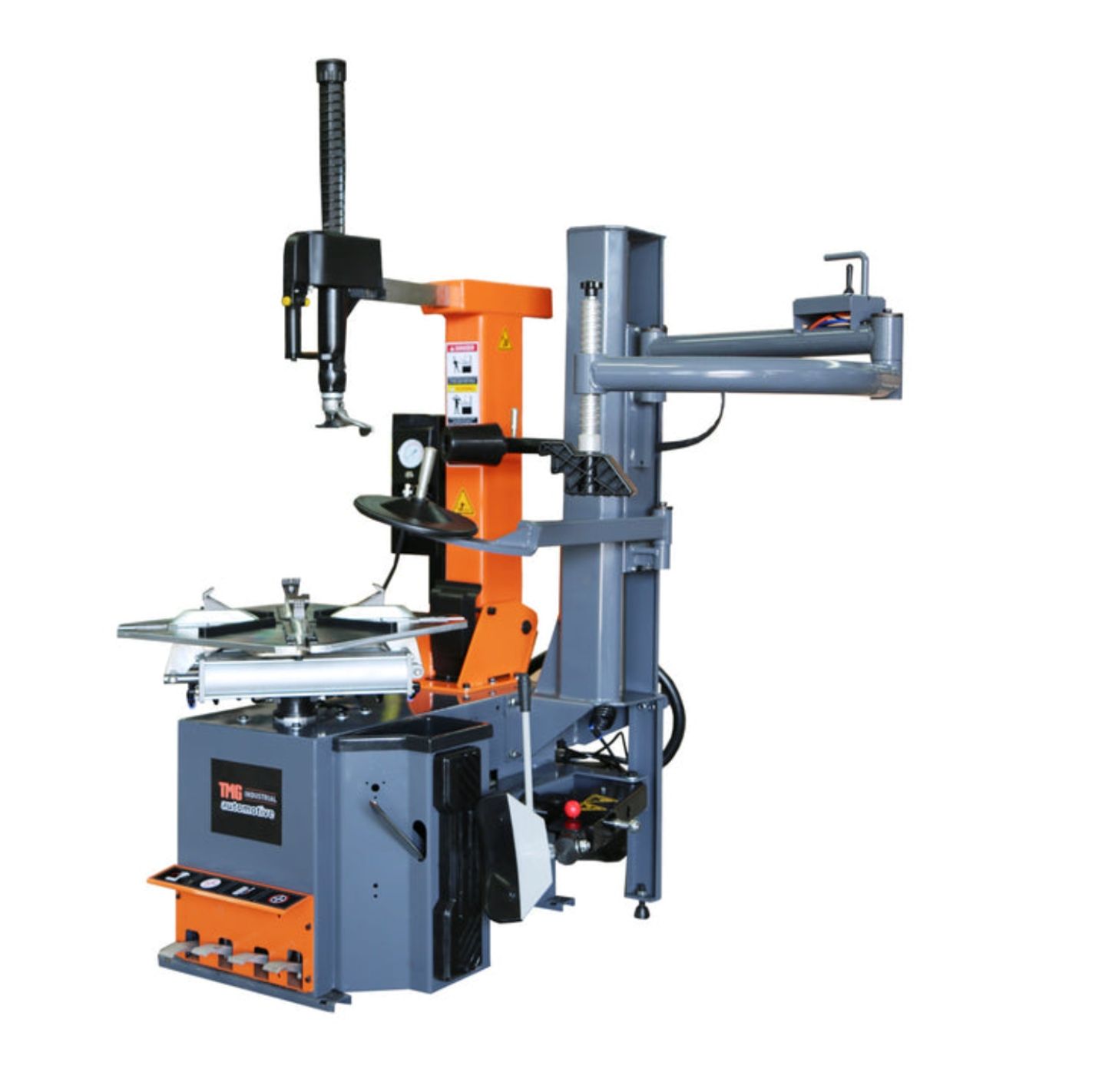
Across Canada, the small tire shop is where winter and summer sets get swapped twice a year, and the bottleneck is rarely the technician. It is usually the machine, or more precisely, what the building can give it. A tire mounting machine looks like a self-contained piece of equipment, but it quietly depends on compressed air, electricity, floor space, and a clear path from the dock. A tilt-back semi automatic tire changer with a built-in assist arm makes those dependencies easy to see, which is why it is a good model to plan around.
Start with the Air Supply
The TMG-TC28A runs its clamping jaws and its assist arm on compressed air, with an operating pressure listed at 115 to 145 PSI. That is a supply question before it is a machine question. A small portable compressor can fill a tire, yet it may struggle to keep pressure steady when the jaws, the arm, and a tire bead breaker all draw air in the same minute.
The spec sheet also lists an air regulator and oil lubricator. Think of the lubricator as a thin film of oil that keeps the air cylinders moving smoothly, much like oil on a bicycle chain. It needs topping up, and the air feeding it should be as dry as the shop can make it, because moisture is what corrodes cylinders from the inside.
Then the Electrical Side
The motor is a 2 HP unit on 120 volt single-phase power. That is ordinary shop voltage, but a 2 HP motor starting under load pulls a real surge. Giving the machine its own circuit, rather than sharing one with a space heater or a bench grinder, is the simplest way to avoid nuisance trips. If the outlet is far from the bay, have an electrician move the outlet. A long, thin extension cord is a poor substitute.
Getting It Through the Door
This model ships in two wooden crates, 650 and 220 pounds, for 870 pounds in total. The bigger crate measures 44 by 35 by 39 inches. Before delivery day, measure the route from the truck to the bay, including door width, ramps, and any tight turn. Delivery can take up to 10 to 15 business days depending on location, so there is time to prepare the floor.
Once the tire mounting machine is in place, think about the space around it, not just under it. The tower tilts back, the swing arm reaches over the wheel, and the technician has to lift a wheel onto the turntable. A wheel up to 41 inches in diameter and 3 to 15 inches wide fits on this machine, so leave room to roll or lift a tall tire without brushing the wall.
Why the Tower Tilts Back
A tire does not come off a rim by force alone. The bead, the stiff edge of the tire, has to drop into the rim's center channel, which gives it enough slack to be lifted over the edge. A tilt-back tower swings the mounting head away from the wheel, so the technician can set the wheel on the turntable and clamp it without working around the post. When the tower tilts forward again, the head returns to the same position each time. That repeatability is what makes a shop's tenth tire as safe as its first.
Four self-centering jaws, driven by dual pneumatic cylinders, grip the rim evenly. Clamping range is 14 to 28 inches from the inside and 14 to 26 inches from the outside. Pedal controls open and close the jaws and turn the table, so both hands stay on the tire.
What the Assist Arm Does
Stiff sidewalls are the hard part of the job. Low-profile and run-flat tires resist the tire iron the way a thick leather belt resists being folded. The built-in TMG-PAT28 pneumatic assist arm presses the bead down and holds it while the head works around the rim. In effect, it is a third hand that does not tire. That reduces operator fatigue, and it also keeps the technician's weight out of the leverage, which is where rims get scratched.
Rim protection is built in as well. Protective covers sit on each jaw tooth, and the mount and demount head is plastic, so aluminum alloy wheels face less metal-on-metal contact. Alloy wheels are common now, and a shop that returns scratched rims loses customers fast. Before the head goes in, mark the valve stem position and keep the head clear of any pressure sensor, because a sensor knocked loose costs more than the whole service call.
Lubricating the bead is part of the same habit. A wet bead slides over the rim edge, a dry one drags, and the drag is what makes technicians fight the tire. Brush it on and wipe off the excess afterward.
A Short Checklist Before Day One
- Confirm compressor output and hose length.
- Install a dedicated 120 volt outlet near the bay.
- Measure doors, ramps, and the crate route.
- Check floor level and anchoring points.
- Stock bead lubricant and valve stem tools.
None of these steps is difficult, and all of them cost less than a mistake on the first set of customer wheels. Anchoring matters more than it sounds, because a machine that rocks under load makes every clamp less certain.
Who It Suits and Who It Does Not
The manufacturer positions this machine for small to medium tire shops and general auto service centers. It takes wheels from 14 to 28 inches, while motorcycle clamping adapters are sold separately. A shop that mounts hundreds of tires a day wants a faster, more automated machine, while a shop doing a few dozen a week is the natural fit. If the assist arm is not needed, the same family includes the TMG-TC28 without it, which is a reasonable decision for a shop that rarely sees stiff sidewalls.
Care, Safety, and the Long View
Maintenance on any tire changer machine is routine and dull, which is the point. Drain moisture from the air line, refill the lubricator, keep the jaws free of grit, and look at the plastic head for wear. Wear eye protection, keep hands clear of the bead area, and never exceed the inflation pressure printed on the sidewall. The unit is CETL certified for Canada and the USA and carries a one-year warranty against defects in materials or workmanship.
The direction of the industry is clear. Wheels are getting larger, sidewalls stiffer, and sensors more common, so the tire mounting machine that fits next year's wheels is the one with a wider clamping range and a helper for stubborn beads. For shops weighing that decision, TMG Industrial lists the TMG-TC28A alongside lower-cost models, and the useful comparison is rim range and arm, not horsepower.