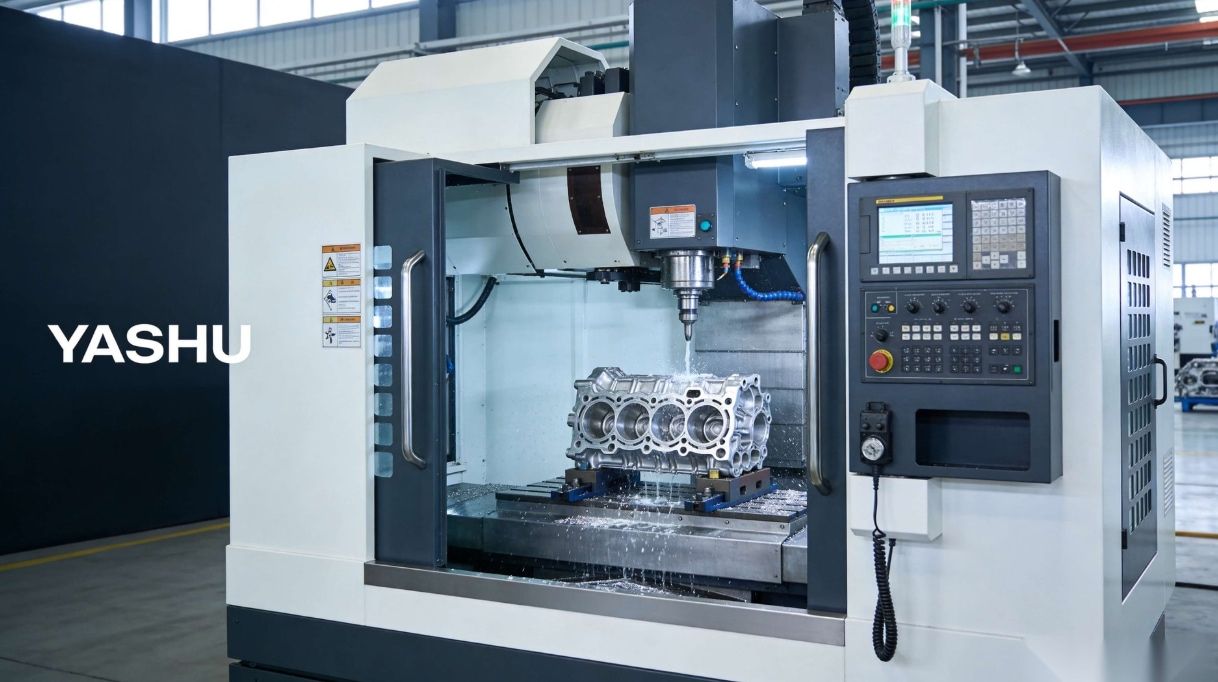
Automotive parts production rewards machines that hold tolerances without operator intervention and repeat a cycle identically on the ten-thousandth workpiece. A vertical machining center earns that job through mechanics rather than marketing: with the spindle aligned on the vertical Z axis, cutting forces close through a short loop of spindle, column, base and table, and chips leave the cut under gravity instead of being re-machined in the bore. For parts like engine housings, brake calipers and the structural brackets required in automotive manufacturing, that geometry - not the control badge - delivers the precision and efficiency this industry budgets for.
Why Does Vertical Spindle Geometry Give Automotive Parts a Precision Advantage?
Every milling operation is a fight between cutting force and machine deflection. When a face mill roughs a cast iron bracket, the load travels from cutting tool through spindle, column and base back into the workpiece. Every joint deflects, so dimensional stability exists only when that loop is short, stiff and well damped. Casting quality and guide type separate machine classes: a ribbed, aged cast-iron base with hand-scraped guideways holds geometry through three-shift duty that lighter frames cannot.
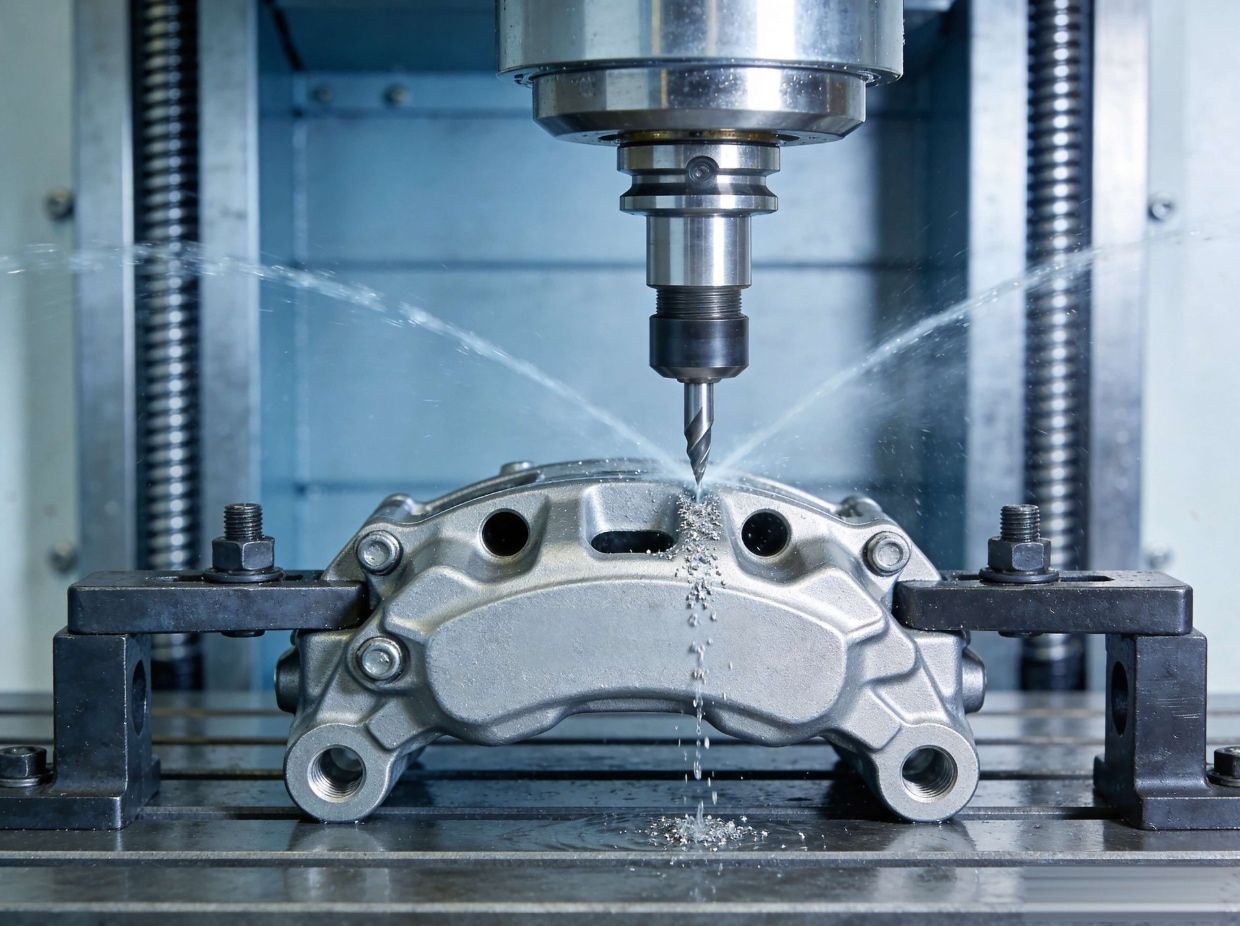
Chip evacuation is the second mechanical advantage. Chips that stay in deep aluminum pockets are re-cut - wrecking surface finish, inflating temperature and shortening cutting tool life. On a vertical spindle, gravity pulls chips out of vertical bores and high-pressure coolant clears the rest. Fixturing follows the same logic: thin-walled A356-T6 castings clamp flat against the horizontal table, spreading holding force across the datum face, so the workpiece keeps its dimensions.
Guide choice splits classes again: box ways absorb harmonic vibration in heavy roughing, while roller linear guides run with low friction, avoid the stick-slip phenomenon and deliver the positioning repeatability finish boring demands - hence their prevalence on machines built for precise machining of aluminum parts.
How Do Vertical Machining Centers Hold Tight Tolerances Across Long Production Runs?
In modern manufacturing, the main enemy of accuracy over a shift is heat, not the spec sheet. An uncompensated spindle can drift 0.02-0.05 mm along Z within the first hour - enough to push a bored H7 fit out of tolerance. Production-grade machines counter with per-axis thermal displacement compensation, jacket-cooled housings and programmed warm-up cycles. A manufacturer publishing measured warm-up data beats one quoting a catalog figure: axis repeatability in the ±0.003-0.005 mm band survives only when heat, backlash and pitch-error compensation are actively managed.
Consistency depends on the production process, not only the machine. In-cycle probing measures critical bores and updates tool offsets automatically, helping reduce human error on lights-out shifts. Cutting data must match the material state: cast A356-T6 runs at 300-800 m/min with carbide, normalized 42CrMo4 forgings at 120-220 m/min with coated inserts, and both shift with stock condition, depth of cut and fixturing rigidity - why credible engineers quote ranges, never single values.
Vertical or Horizontal Machining Centers - Which Layout Fits Automotive Production?
These machining methods differ enough that ISO maintains separate geometric test standards for horizontal-spindle and vertical-spindle machining centers; choosing the right machining method should follow part geometry, not habit. Horizontal machining centers excel where a prismatic part needs features on several faces in one setup - transmission valve bodies are the classic case - or where pallet pools run unattended. Vertical machining centers win on setup economy and visibility for parts with tight tolerances machined mainly from one datum face: engine housing decks, pump housings and caliper bodies. For small to medium-sized parts, the key advantages of a vertical setup - simple fixturing, faster changeover, lower capital cost - usually outweigh multi-face access. Automotive production cells in the tier-2 supply chain typically run both, matching the right type of CNC milling machine to each automotive component family.
Which Automotive Components Depend on CNC Vertical Machining?
The modern automotive industry divides its machined portfolio into aluminum castings, wrought aluminum, cast iron and steel forgings, with nickel alloys the advanced materials on the exhaust side. Automotive manufacturers keep tightening those budgets, and vertical machining centers carry a large share: engine housing and pump-housing deck faces, transmission case bosses and bores, brake calipers, steering knuckles and a wide range of structural parts. Turned features stay on the lathe; everything prismatic lands on a machining center. Sealing faces play a critical role in leak control - typically flatness within 0.02-0.05 mm and surface finish near Ra 0.8 µm, while general faces carry Ra 1.6-3.2 µm callouts under the current ISO 21920 profile rules that replaced the withdrawn ISO 4287 and ISO 1302. High-precision H7 bores demand rigidity and thermal discipline, and this wide range of materials is why spindle torque curves matter more than peak rpm. For complex parts that require intersecting bores, automotive CNC machining provides the only economical route to high-volume production.
How Do Vertical Machining Centers Cut Cycle Time and Labor Costs?
Production efficiency is built from seconds. A modern automatic tool changer completes cut-to-cut changes in roughly 1.5-3 s on production-class machines - a figure that compares honestly between builders under test conditions standardized in ISO 10791-9. Rapid traverse and high spindle speeds - the visible face of CNC technology - only pay off when interpolated motion holds its precision and accuracy at working feed; ISO 10791-6 defines how that behavior is verified, worth checking before trusting the look-ahead claims of advanced CNC controls.
Beyond the machine, automation reshapes surrounding manufacturing processes. Fourth-axis fixtures and tombstones let one machine produce parts continuously, robotic loading lets one operator tend two or three CNC machines, and in-cycle probing removes measurement stops. On the mixed schedules of tier-2 automotive manufacturing, where supply chain calls shift weekly, these cut machining time and labor costs more reliably than chasing spindle speed alone.
Choosing a Vertical Machining Center: What Separates a Production Machine from a Spec Sheet?
Serious evaluation looks past travels and spindle speed on the spec page. No CNC machine can rescue a machining process from a mismatched spindle torque curve - a 12,000 rpm rating that flatters aluminum is nearly useless for roughing forgings if torque collapses at low speed. Axis travels need headroom for the fixture, fourth axis, tool overhang and the part family's machining requirements - not just the part envelope. Among CNC machine tools, base casting grade, aging treatment and guide type decide whether the accuracy certificate survives three shifts; a builder's reliability record outweighs any line item. ATC capacity, coolant pressure and probing round out the shortlist.
Within a builder's range of vertical machining centers, the right vertical platform is the machining solution sized to actual manufacturing needs. YASHU approaches the automotive segment with the Heavy-Duty CNC Vertical Machining Center YS-850/850D: an aged, ribbed cast-iron base, roller guides matched to the duty cycle, a dynamically balanced spindle for high-speed aluminum, and through-spindle coolant with fourth-axis readiness for parts that require multiple machining operations in one setup. Facilities planning a cell can request a cycle-time study on their own drawings from the YASHU applications team before committing to a layout.
FAQs
What positioning repeatability should a production VMC guarantee for automotive parts?
Production-class machines quote axis repeatability in the ±0.003-0.005 mm band. Request the machine-specific test report, not a catalog value; high precision and repeatability on the floor depend on environment, fixturing consistency and warm-up discipline.
Can a VMC handle hardened die components for automotive stamping tools?
Within limits, yes. HRC 48-52 die inserts machine well on a rigid platform with ceramic or PCBN tooling, light depths of cut, reduced cutting speed and a stiff setup - practices proven in aerospace and die work.
How much thermal drift is normal, and how is it controlled?
Uncompensated drift of 0.02-0.05 mm during the first 60-90 minutes of spindle warm-up is common. Control comes from per-axis thermal displacement compensation, oil chillers and scheduled warm-up programs before tolerance-critical cuts.
VMC or horizontal machining centers for aluminum transmission cases?
If most features machine from one datum face, a vertical setup with a strong fixture is usually more economical per part; if the case needs four-face access, the horizontal layout wins at higher capital cost. Many suppliers quote both.
How quickly does upgrading from a manual mill or legacy machine pay back?
Tier-2 documentation typically shows 20-40% cycle-time reduction when a part moves to a modern platform such as the Heavy-Duty CNC Vertical Machining Center YS-850/850D with probing, a fast ATC and fourth-axis workholding. Labor costs per part fall further once one operator tends multiple machines; payback depends on part mix and shift pattern.