Few exterior lighting upgrades deliver as much visual and functional return per minute of labor as side marker replacement on a Mercedes or Porsche. The factory units on a W211 E-Class, a 986 Boxster, or a 996 Carrera pair an incandescent bulb with an amber lens, and years of heat cycles, stone chips, and UV exposure leave clear evidence: faded plastic, corroded bulb sockets, hairline cracks in the light housing. LED side marker lights resolve all of those failure modes in one direct replacement - sharper light output, a flush lens profile, and a service life measured in years rather than bulb changes.
What Are Side Marker Lights and Why Do They Matter on a Mercedes or Porsche?
Side marker lights mount in the front fender and rear quarter, around the wheel well, and communicate the vehicle's presence, position, and length to side traffic. FMVSS 108 requires amber front markers and red rear units in the US, which is why US-spec Porsche and Mercedes models carry the amber lens while Euro-spec cars use a side turn repeater. For an imported Euro car facing state inspection, a dead marker is a straightforward fail.
The originals fail for a reason worth understanding. An incandescent bulb inside a sealed cavity runs hot: heat yellows the lens from the inside, bakes the socket, and corrodes the terminals. Most dead OEM side markers on twenty-year-old German cars are thermal and corrosion failures, not electrical ones - and orange side markers visually date the entire car.
Why Upgrade the OEM Side Marker to LED?
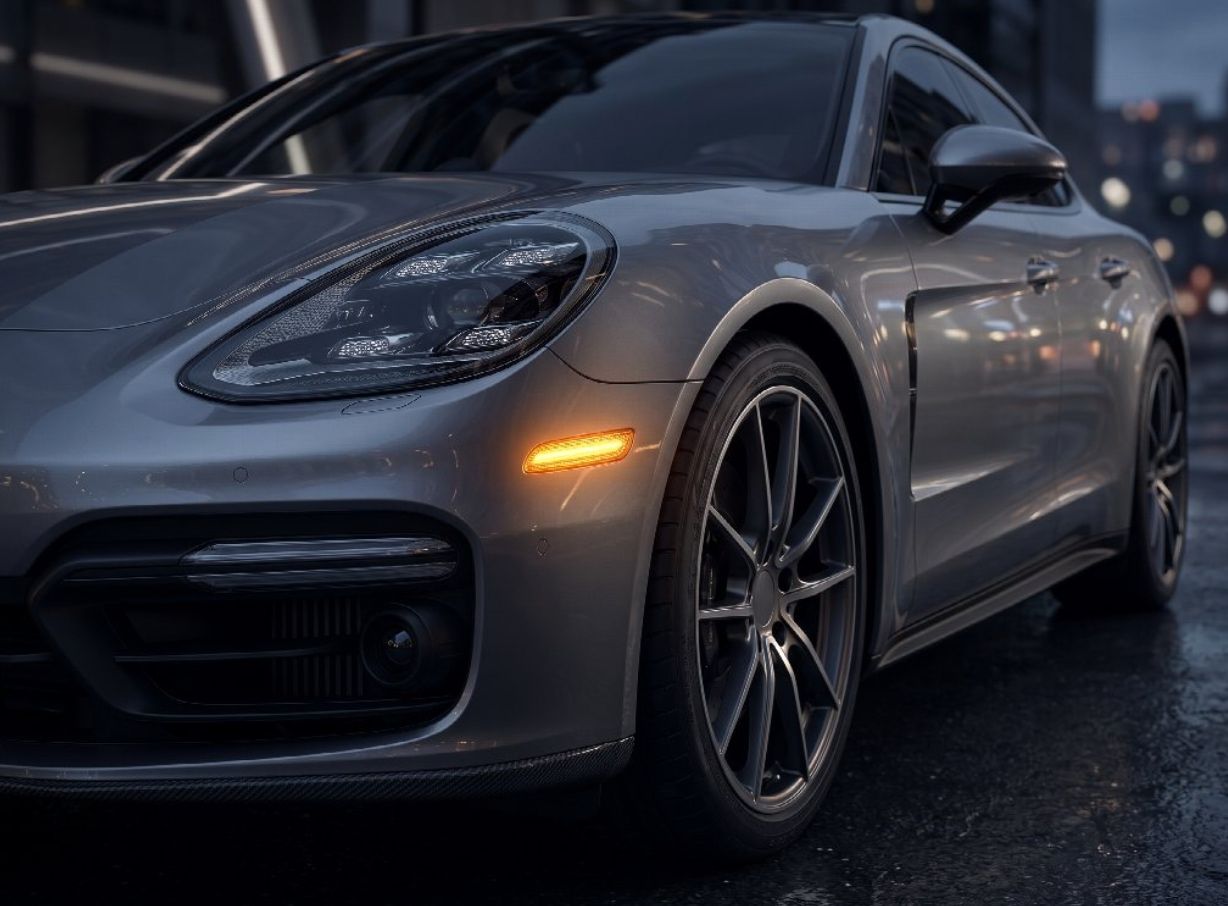
An original replacement bulb costs little and changes nothing: the lens stays faded, the amber stays dull, the filament stays vulnerable. A filament bulb in a wheel well lives a hard life - suspension and road harmonics transmit straight into the bulb and socket, which is why markers die long before cabin lamps do. LEDs have no filament to shake apart, illuminate instantly (relevant every time the marker flashes with the turn signal), and draw a fraction of the current. The aesthetic gain is just as real: a clear lens over a modern amber LED reads crisp against the paint, and quality housings mount flush where the originals protruded. Few lighting upgrades on either marque match that effort-to-result ratio.
Clear or Smoked Lens - Which LED Side Marker Style Suits the Vehicle?
Clear side markers show an amber or white LED behind clean plastic and suit lighter paints and OEM-plus builds. A smoked lens disappears against black, dark grey, or a performance specification like a 718 Cayman GTS with dark trim. Style is the easy half of the decision; photometric compliance is what separates a quality smoked marker from a cheap one. Tint reduces transmitted light, so a properly engineered unit compensates with a higher-output LED to hold the candela rating required for side visibility. Lamps that simply dim below the legal minimum undercut the marker's core job - alerting other drivers - and can fail inspection outright.
How to Choose LED Side Markers That Fit Without Error Codes?
Genuine Porsche and Mercedes dealer parts guarantee fitment and carry a warranty, at a price to match. The aftermarket splits into two tiers worth telling apart. Public-mold tooling - generic housings sold under dozens of labels - usually pairs a basic LED with a resistor circuit that fakes the load of a filament bulb. That works, for a while, but the resistor dumps surplus energy as heat into a housing never designed to dissipate it, and heat kills LED junctions. The better tier uses a proper driver circuit, UV-stabilized polycarbonate lens, and connectors molded for the platform's socket.
Application-specific engineering decides whether installation is truly plug-and-play. A 718 Cayman, a 986 Boxster, a 911, and a W211 E-Class each use different retention geometry and connectors, and a kit with the correct spring clips installs without trimming, splicing, or warning lamps. Mercedes W211 LED Side Marker Lights and Porsche 986 996 LED Side Marker Lights show what platform-specific coverage looks like. Addcarlights publishes an application chart by model and year, which beats guessing at a one-size-fits-all listing.
What Does LED Side Marker Installation Involve?
The job ranks as one of the easiest lighting tasks on either marque. Tools: a plastic trim removal tool, a microfiber cloth, occasionally a small flathead screwdriver. Pry gently at the inboard edge of the original marker until the spring clips release, keeping the cloth between tool and paint. Disconnect the connector from the bulb socket, plug the LED unit into the factory harness, and snap the new marker in until it seats flush. No bumper removal, no wiring, no soldering. Verify function before closing up: marker lit, turn signal flashing at the correct rate, no error messages on the dashboard. Total time runs ten minutes per corner, and the process is identical on the E-Class.
How to Prevent CANbus Error Messages and Hyper-Flash?
Modern Mercedes and Porsche body electronics monitor lamp circuits by measuring current draw, and an LED's low consumption reads as a burned-out bulb to the cold-diagnosis routine. Three fixes exist: integrated CANbus decoders that present the correct load signature to the body module, an inline external resistor, or coding the check out of the module - the last belongs to specialists only. Integrated decoders are the clean answer; external resistors work but generate heat and need mounting away from harness insulation. Flicker usually traces to a connector not fully seated or corrosion on the socket terminals. Clean the contacts, reconnect firmly, and the fault almost always clears.
What Keeps LED Side Markers Bright and Leak-Free Over the Long Term?
Maintenance is minimal. Wash the lens with mild automotive cleaner rather than solvents that haze plastic. Inspect the seal line after heavy rain or repeated car-wash cycles; a compromised seal lets condensation form inside the housing. Fogging that clears within a day is normal breathing; standing water signals a failed seal. Ultrasonic-welded or gasket-sealed housings with UV-stabilized lenses resist exactly this. A dab of dielectric grease on the connector prevents the terminal corrosion that plagues aging German wiring. Built right, an LED marker outlives the vehicle around it.
FAQs
Do LED side markers trigger bulb-out warnings on Mercedes and Porsche models?
Only when the circuit lacks load simulation. CANbus-ready LED side marker lights hold the current signature the body computer expects, so no error message appears and the indicator flashes at the correct rate. Resistor-only units work but add a heat source that shortens service life. E-Class owners can confirm decoder compatibility in the Mercedes W211 LED Side Marker Lights application notes before ordering.
Are smoked side markers legal for street use?
Where side markers are mandated, the front lamp must emit amber. A properly engineered smoked lens passes because the LED compensates for the tint; a unit that falls below the required candela rating fails both the law and the lamp's function.
How long do LED markers last compared with the original halogen bulbs?
A quality LED marker typically runs tens of thousands of hours, versus roughly a thousand for a filament bulb subjected to wheel-well vibration. Lumen depreciation, not outright failure, sets the real replacement interval.
Will one set fit every Porsche model?
No. A 718 Cayman, a 986 Boxster, and a 911 use different housing geometry and connectors. Application-specific kits built per chassis, with the correct spring clips and socket, install without modification. Addcarlights lists coverage by model and year.
What causes condensation inside a side marker, and when is it a defect?
Brief fogging that clears as the lamp breathes is normal. Persistent moisture or standing water means the seal has failed, usually at the lens-to-housing joint. Welded or gasket-sealed housings avoid this failure mode almost entirely.