How long can truck drivers legally drive in Texas? The answer determines whether a load keeps rolling or the truck parks for the night. Understanding truck HOS violation penalties starts with knowing which driving limit applies.
For most property-carrying drivers under federal Hours of Service (HOS) rules, the ceiling is 11 driving hours after 10 consecutive hours off duty, all inside a 14-hour window, with a 30-minute break owed after eight cumulative hours of driving and a weekly cap of 60 on-duty hours over seven days or 70 over eight. Cross one of those lines, and truck hours of service violation penalties can follow: an out-of-service order at the roadside, civil fines against the driver or the carrier, and a violation entered into federal safety data that lingers for years.
When a trucker breaks HOS rules in Texas, it doesn't automatically mean that federal limits, current in 2026, apply. Texas-only operations, passenger carriers, short-haul drivers, sleeper-berth schedules, and genuine emergencies each get their own analysis.
Federal Driving Limits on Texas Roads
Federal HOS rules govern Texas roads whenever the driver and the operation fall inside federal jurisdiction. Texas offers no special driving allowance for an interstate haul.
The core limits are in 49 C.F.R. § 395.3, which covers property-carrying commercial motor vehicles. A commercial motor vehicle, in this context, is a vehicle used in business that crosses a federal threshold tied to weight, passenger capacity, or hazardous cargo.
| Rule | General federal limit for property carriers | What it means in practice |
|---|---|---|
| Driving limit | 11 hours | Available only after 10 consecutive hours off duty |
| Duty window | 14 consecutive hours | The driver generally cannot drive after the 14th hour following the start of duty |
| Break | 30 minutes | Required after eight cumulative driving hours without a qualifying interruption |
| Weekly cap | 60 hours in seven days or 70 hours in eight days | Other work may continue, but the driver cannot drive a regulated commercial motor vehicle after reaching the cap |
| Restart | 34 consecutive hours off | May reset the driver's seven-day or eight-day calculation |
The 11-Hour Rule Versus the 14-Hour Window
These two limits measure separate things, and the confusion costs drivers real hours. The 11-hour rule counts only time behind the wheel. The 14-hour rule is a clock: it starts the moment the driver comes on duty after the 10-hour break and never pauses, whether the truck is rolling or the driver is waiting at a dock.
Picture a driver who starts at 6 a.m. The cutoff is 8 p.m., even if three hours went to a receiver's yard and the log shows only eight hours of driving. Unused hours vanish. A fresh 10-hour off-duty stretch is the only way to start over.
Breaks and the Weekly Cap
After eight cumulative driving hours, the driver needs at least 30 minutes of interruption: off-duty time, sleeper-berth time, or on-duty work like a qualifying inspection or unloading. Fueling counts as on-duty non-driving time if the driver steps away from the wheel.
The weekly cap tracks the carrier's schedule. Carriers that do not run commercial vehicles seven days a week use the 60-hour limit; carriers that operate daily use the 70-hour, eight-day version. Hitting the cap stops regulated driving, not all work. Paperwork, warehouse duties, and inspections can continue.

A single duty cycle for a property-carrying driver: 10 hours off, then up to 11 driving hours inside a 14-hour window with a required 30-minute break.
Drivers Covered by Federal HOS Rules
Federal HOS rules apply to drivers operating qualifying commercial motor vehicles in interstate commerce, even when a trip never leaves Texas. Interstate commerce includes any shipment that crosses a state or national boundary, including a Texas leg of freight that began or will end elsewhere.
Coverage hinges on the vehicle, its passenger capacity, placarded hazardous materials, and the interstate character of the run. A commercial driver's license is not the only test. Many drivers fall under federal HOS rules in vehicles that require no CDL.
Federal Rules Versus Texas Intrastate Rules
Intrastate commerce means transportation that begins and ends inside Texas with no interstate character. A driver in that category may qualify for the state provisions in 37 Texas Administrative Code § 4.12.
Texas gives an eligible intrastate property-carrying driver more room: up to 12 driving hours after eight consecutive hours off, inside a 15-hour duty period, with a 70-hour cap over seven consecutive days.
A carrier cannot simply pick the friendlier schedule. The operation has to genuinely remain intrastate and meet the state's requirements; Texas intrastate limits do not apply to interstate freight hauled for convenience. And passenger-carrying vehicles follow separate limits entirely. Measuring a motorcoach driver against the 11-hour property-carrier rule is a mistake.
How the Trump CDL Changes Affect HOS Rules
The Trump administration's CDL-related changes did not replace the federal HOS limits. The phrase “new CDL law” generally refers to measures involving English-language proficiency enforcement and tighter eligibility for non-domiciled commercial driver's licenses. Those requirements affect who may legally hold or use a CDL, while HOS rules still control how long a covered driver may drive.

Exceptions That Can Change a Driver's Schedule
Three exceptions matter most: adverse driving conditions, short-haul operations, and sleeper-berth splits. None grants an unrestricted right to keep rolling, and none excuses driving while fatigued. The FMCSA's summary of the Hours of Service regulations spells out the conditions attached to each.
Adverse Driving Conditions
Conditions must have been unforeseen when the run began, judged by what the driver or dispatcher reasonably knew at dispatch. Sudden snow, unexpected fog, a road closure, or a crash-triggered backup can qualify.
For property carriers, the exception adds up to two driving hours and stretches the window by two more, permitting as many as 13 driving hours inside a 16-hour window when everything lines up.
Routine rush-hour congestion on I-35 will not cut it. Nor will a storm already in the forecast, familiar ongoing construction, or sloppy trip planning.
Short-Haul Operations
A qualifying short-haul driver must return to the normal reporting location within 14 hours and stay within a 150-air-mile radius of that spot.
Short-haul status mainly changes recordkeeping and break obligations. It does not grant extra driving time beyond the 11-hour ceiling. Carriers must still keep accurate time records even when the driver is exempt from a standard record of duty status or electronic log entry.
Split Sleeper-Berth Time
Splits are commonly described as 8/2 or 7/3. A qualifying pair of periods, one with a minimum of seven straight hours in the sleeper berth and the other with at least two consecutive hours off duty or in the berth, can together satisfy the 10-hour requirement if the two total 10 hours or more. Neither period counts against the 14-hour window.

Truck HOS Violation Penalties and Roadside Consequences
Hours of service violation penalties for truck drivers can begin at the roadside. When a driver blows past a limit, an inspector can record the violation and park the truck until the driver has banked enough rest to resume legally. The driver or carrier may face civil penalties, compliance consequences, and heavier scrutiny at the next safety review.
What Happens After an HOS Violation
An officer or safety investigator may pull the electronic log, the supporting documents, or the paper duty records and match the timeline against the limit in force. If the violation meets out-of-service criteria, the driver sits until it is corrected, and the carrier may need a relief driver or a delayed delivery.
The violation lands in federal safety data, and an out-of-service order may accompany it. Civil enforcement can reach the driver, the carrier, or both, and repeated violations raise a carrier's compliance exposure. Falsifying a log or driving in violation of an out-of-service order carries separate consequences.
Federal civil penalty maximums adjust for inflation, so the applicable amount depends on the official schedule for the year of the violation.
How Long a Violation Stays on a Record
Retention isn't a single number because several records are involved. Carrier Safety Measurement System calculations draw on roadside inspection data from the previous 24 months and weight recent events more heavily.
A driver's Pre-Employment Screening Program report typically covers three years of inspection data and five years of crash data. Court records, employer files, and state driving records each follow their own schedules.
How Many Points an HOS Violation Carries
No fixed nationwide point value exists. Federal safety systems assign severity weights violation by violation, and recency plus the carrier's inspection exposure shape how the data is scored. Those calculations are separate from Texas driver's license points and from any criminal conviction.
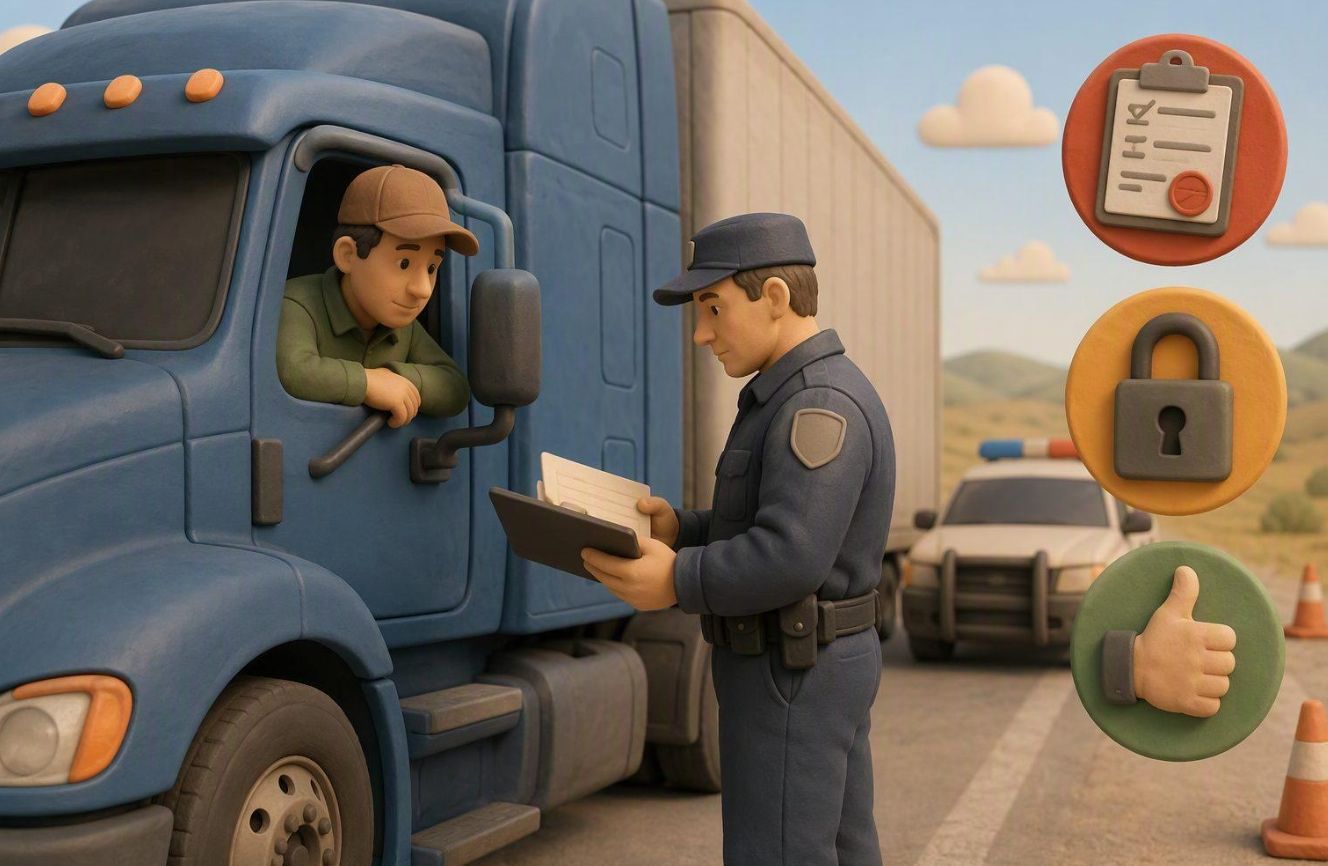
A roadside inspection can end in a recorded violation, an out-of-service order, or release once the driver is legally permitted to continue.
Carrier Responsibility, Electronic Logs, and Crash Evidence
Can a trucking company be fined for HOS violations? Yes. A trucking company can face penalties for HOS violations when it permits, requires, or fails to prevent prohibited driving. Federal rules go further: carriers, shippers, receivers, and transportation intermediaries are barred from coercing a driver into violating commercial vehicle safety regulations.
The paper trail of carrier responsibility shows up in dispatch schedules, messages pressuring a driver past a limit, ignored log warnings, inaccurate records, or instructions letting an out-of-service driver roll anyway.
What Electronic Logging Devices Show
An electronic logging device (ELD) is engine-synchronized hardware that automatically records driving time: duty status, status changes, vehicle movement, location, and every edit made to the record.
But the ELD is not the whole record. Dispatch messages, fuel receipts, toll records, bills of lading, inspection reports, and engine data can confirm or contradict a log. Carriers must generally retain duty records and supporting documents for six months.
An HOS Violation Does Not by Itself Prove the Cause of a Crash
A violation shows that a driver or carrier broke a safety rule. It does not, on its own, show why the collision happened. The evidence must still connect the breach or resulting fatigue to the crash, and the carrier may contest causation, the driver's regulatory status, or the rule's application.
Duty logs and inspection reports belong alongside the physical evidence, vehicle data, witness accounts, dispatch communications, and the full timeline leading up to impact.

ELD records document driving status and duty changes, but they do not independently establish what caused a crash.
What This Means for You
Before judging whether a driver exceeded the legal hours, pin down which rules governed that day. The shipment's interstate character, vehicle type, duty records, exceptions in play, and the carrier's instructions all shape the analysis.
If you are reviewing a crash or inspection, preserve the records promptly and read the whole duty timeline. The violation that matters may appear hours before the final ELD entry.
Related Questions
What happens when a trucker breaks HOS rules in Texas?
An inspector can document the violation and, once out-of-service criteria are met, keep the driver off the road until the driver completes enough rest. Civil enforcement may follow, shaped by the violation, the driver's history, the carrier's conduct, and any falsified records.
Can a carrier be penalized when its driver exceeds the limit?
Yes. A carrier faces enforcement when it allows, requires, or pressures a driver into violating HOS rules, or when it fails to keep accurate records. Responsibility is not confined to whoever was holding the wheel.
Which drivers must follow federal Hours of Service regulations?
Drivers operating qualifying commercial motor vehicles in interstate commerce. Vehicle weight, passenger capacity, hazardous-material status, and the nature of the operation all factor in, so a CDL is not the only test.
What counts as an exception to the HOS regulations?
The short-haul exception, unforeseen adverse driving conditions, qualifying sleeper-berth splits, and certain emergency operations. Each carries its own conditions, and none licenses a driver to operate fatigued.
Does an HOS violation carry a fixed number of points?
No. Federal safety systems assign severity weights violation by violation, separate from Texas driver's license points. A carrier's safety data shifts over time as newer inspections come in.
First, sort out the driver's regulatory category. Then read the full duty timeline before drawing any conclusions about legal hours.