When people argue about car prices, the conversation usually lands on the obvious levers: steel and aluminium prices, energy costs, exchange rates, labour. All of that is real. But a big slice of what it costs to build a modern vehicle is decided much earlier and much further down the supply chain, in the shops that machine the metal parts an engine and chassis are built from. That work is mostly CNC machining, and it has a bigger say in the final sticker than most buyers realise.
What actually gets machined in a car
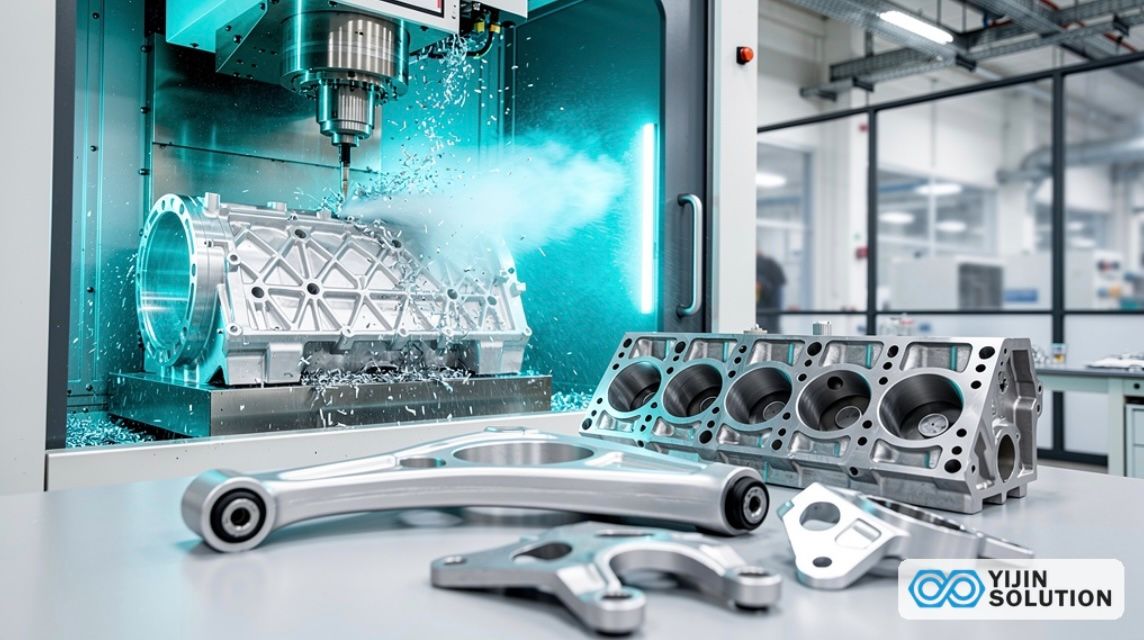
A modern vehicle is full of machined metal. Engine blocks, cylinder heads, pistons and connecting rods all start as castings or forgings and then get machined to their final tolerances. Transmissions are full of machined gears, shafts and housings. Suspension and steering rely on machined control arms, steering knuckles and mounting brackets. Brake and fuel systems use machined fittings and bodies. Turbochargers are machined assemblies in their own right.
The common thread is precision. An engine bearing surface, a valve seat, a gear face: these have to be held to tolerances measured in thousandths of a millimetre, then repeated identically across hundreds of thousands of parts. That repeatability is the whole game. A part that is within spec but inconsistent is a warranty claim waiting to happen, which is exactly the kind of problem that turns into a recall a few years later.
Why precision is a cost story, not just an engineering one
Tolerance and cost are tied together more tightly than most people assume. Hold a looser tolerance and the part is cheap but the failure rate climbs. Hold a tighter one and the part costs more up front but lasts, fits better and warranties less. The automakers who get this balance right are not the ones spending the most on machining. They are the ones spending it in the right places.
This is also where supply-chain economics bite. When metal prices spike or energy costs jump, machining shops feel it first, because they buy the raw stock and run power-hungry equipment. Those costs flow downstream into component prices and, eventually, into the vehicle. The shops that absorb pricing pressure best tend to be the ones running automotive CNC at scale, with the volume and process control to keep per-part costs predictable even when input prices are not.
Prototype to production is where time gets won or lost
There is another cost hidden in the development timeline. Before a new part reaches the line, it goes through prototyping and validation, often many rounds of it. Every round that takes weeks instead of days pushes the program back and adds engineering cost. CNC machining matters here too, because the same equipment that runs production can cut a one-off prototype in a few days, in the real production material, so what you test is close to what you ship.
The manufacturers that move fastest here lean on suppliers who can do both: rapid machined prototypes early, then high-volume production runs of the same part once the design is locked. Keeping that under one roof, with proper quality systems and CMM verification behind it, is what stops a small tolerance drift from becoming a field problem at 60,000 units.
Why this shows up in the data
For anyone who follows the numbers, this is the layer underneath the headline figures. When a brand's per-unit margins hold up through a rough cost cycle, part of the explanation is upstream manufacturing discipline that never makes the press release. When another brand keeps eating recall costs and warranty reserves, some of that traces back to parts that were not made consistently enough in the first place.
Machining is not the only factor in what a car costs or how reliable it turns out to be. But it is one of the least visible and most decisive, and it is worth remembering the next time a manufacturer's results look better or worse than the raw input prices would suggest.