With winter close across much of the United States, more vehicle work moves into the home garage, where space is limited and a floor jack is the usual tool. A portable automotive scissor lift offers a safer way to raise a car or a light truck, and it lies flat when not in use. The surprise for most buyers is that the lift is the easy part. The floor, the ceiling, and the outlet decide whether it works in the space available.
How a Scissor Lift Raises a Vehicle
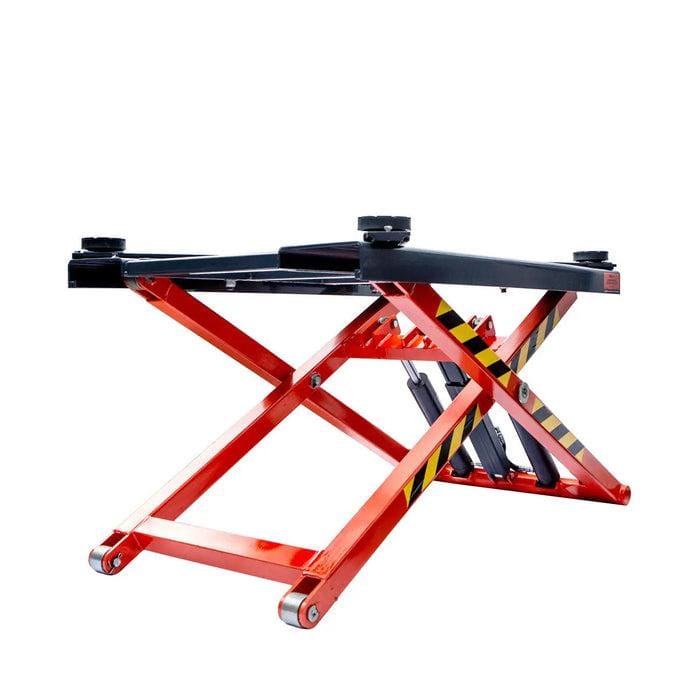
A scissor lift uses two sets of crossed steel arms joined at a center pivot. A hydraulic cylinder pushes the lower ends of the arms toward each other, and the platform rises as the crossed arms stand more upright. Think of a pair of scissors opened on a table: closing the handles lifts the tips.
The hydraulic pump supplies oil under pressure, and the pressure is what carries the weight, so the platform rises steadily and in a controlled way. Because oil does not compress easily, the platform rises smoothly and holds its position until a valve is opened. This is also why a leak in a hose or fitting matters: pressure falls, and the platform can sink if the mechanical lock is not set.
What Mid Rise Means in Practice
A mid rise scissor lift raises a vehicle to about waist height, roughly four feet, instead of full standing height. That is enough to work on brakes, wheels, and fluids while seated on a stool or a creeper, and enough to reach under most vehicles. It does not replace a two-post lift when a technician must stand upright under a car for a transmission job.
Start with the Floor
A lift concentrates the weight of a vehicle onto a small area. The floor under it must be solid, level concrete without large cracks or patched sections, because every pound of the vehicle passes through the platform into the slab. Asphalt, pavers, and sloped surfaces are poor choices.
A slab that looks sound can still hide a weak spot. If the garage floor is old, cracked, or poured thinly over fill, ask a contractor to inspect it before the lift goes in, because a failed slab under a raised vehicle is a serious hazard. Keep the lift away from floor drains and expansion joints.
Then the Ceiling and the Door
Four feet of lift height seems modest until the height of the vehicle is added on top. A sport utility vehicle raised to the maximum can come within inches of a garage door track, an opener rail, or a hanging light. Measure from the floor to the lowest obstruction, add the height of the vehicle, and leave a margin.
Space around the lift matters too. A technician needs room to walk around it, to roll a toolbox beside it, and to open doors without pinching a hose, so a bay that looks large enough for the platform alone may feel cramped once a vehicle is on it.
Power and Hydraulics
The power unit sits on a cart and connects to the lift with a hydraulic hose, so it can stand a few feet away from the work area. It runs on ordinary household current, but the motor draws a large surge at startup. Plug it into a circuit that is not shared with a freezer or a compressor, and avoid long, thin extension cords.
An electrician can confirm what the panel supports. Moving an outlet is a smaller cost than a tripped breaker in the middle of a job, and a dedicated circuit also reduces the voltage drop that makes a motor run hot and slow, which shortens its life.
Locks and Safe Practice
The lift has a safety lock bar with several positions. The lock is a mechanical backup, not a license to be careless, and a hydraulic system alone should never be trusted to hold a load over a person.
Raise the vehicle and set the lock at the nearest position.
Lower onto the lock before starting work.
Chock the wheels that stay on the floor.
Keep hands and feet clear of the arms.
These habits take seconds and prevent the most serious accidents. The arms should also be placed under the lift points that the vehicle manufacturer specifies, not under body panels, and children and bystanders should stay well away while the lift is in use.
Lift Types and Accessories
Scissor lifts come in low rise, mid rise, and full rise forms, and a mid rise scissor lift sits between the two in both height and cost. Two-post and four-post lifts raise a vehicle higher but need a fixed installation and a taller ceiling. Adapters and extension pads let one lift fit cars, sport utility vehicles, and light trucks with different frame shapes.
Buyers who search for a portable car lift or a car scissor lift are usually weighing exactly this trade. A portable unit gives up height in return for flexibility. It can be stored against a wall, which suits a shared garage where the cars must still fit, but it cannot match the working height of a fixed lift, and it is less suited to long jobs under the vehicle.
Where a Portable Lift Helps and Where It Does Not
The advantages are speed, safety compared with jack stands, and easy storage. The tire and brake work that fills a typical garage season becomes far less tiring. The limits are working height, floor requirements, and a power unit that must be placed carefully. A typical case is an enthusiast who changes brakes and tires on a weekend. Raising the car in under a minute makes small jobs happen more often, and the work is done at a comfortable height.
A busy shop that runs lifts all day will want a faster, fixed installation. Capacity also matters. The rating, about six thousand pounds for this lift, must be compared with the curb weight of the heaviest vehicle, with margin for anything loaded inside.
Heavier Vehicles and Where Lifts Are Heading
Vehicles are getting heavier, partly because of batteries in electric models, and lift ratings are following. Manufacturers are also adding more safety features to lifts, such as additional lock positions and clearer lift point markings. Buyers increasingly check the rated capacity, the lift points, and the floor before the lift itself. For anyone moving up from jacks and stands, the useful comparison is the measurements of the garage against the dimensions the manufacturer publishes, and TMG Industrial gives those figures for this lift.